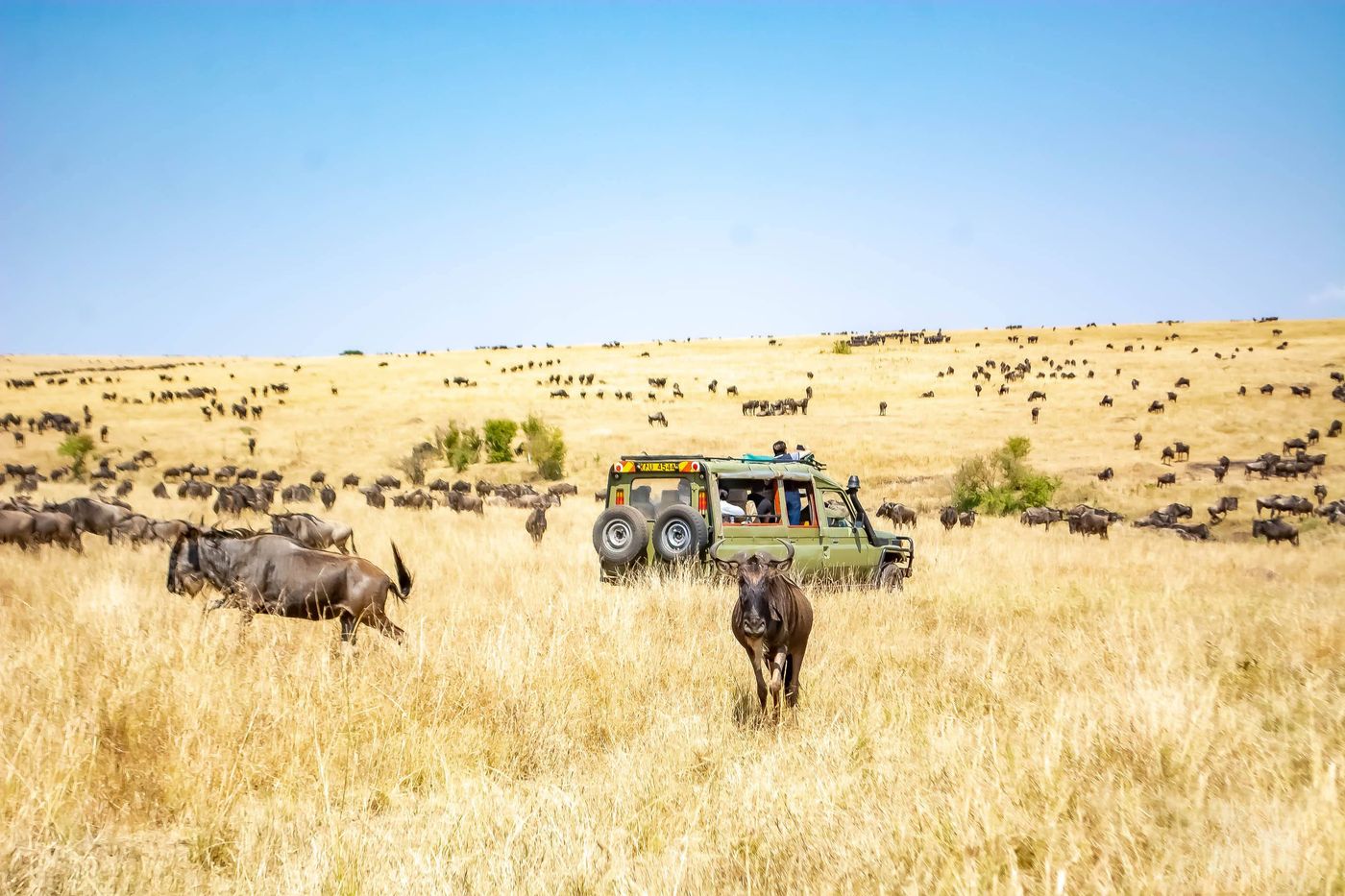
The Maasai Mara is the right place to start, because almost everything that makes it one of the most valuable tourism assets on the continent depends on a climate behaving as it used to. The great migration, when well over a million wildebeest cross from the Serengeti into Kenya, is not scheduled. It follows the rain and the grass, and the famous crossings of the Mara River happen when rainfall, river levels and herd pressure align. An entire economy has been built on predicting that alignment: camps sell fixed-date packages months ahead, vehicles are booked, and a traveller flies from Europe for a week timed to catch the river. The product being sold is, in effect, the reliability of a natural event. That reliability is now weakening. Recent seasons have seen the timing of the Mara crossings drift later and grow less predictable, driven by rainfall patterns that researchers link to climate variability, and while the shift so far is measured in weeks rather than months, a sector that sells a traveller a fixed date does not need the event to vanish to be hurt. It only needs the event to stop being predictable.2
The water is the sharper threat, and here the damage is already physical. A peer-reviewed study of the Maasai Mara published in the journal Climate documents what increasingly intense rainfall has done to the reserve: bridges destroyed, including the Mara Bridge and the newly built Talek River Bridge, and tented camps in low-lying areas flooded and swept away. Anyone who has spent time in the Mara knows why. Many of the most sought-after camps are built exactly where the value is, on the banks of the Mara and the Talek, close to the crossings and the game, which is also exactly where a river swollen by heavier and more erratic rain will reach when it rises. The study's own recommendation tells the story of the gap: it says more resilient lodges should be built in areas not prone to flooding as part of a climate adaptation strategy. That the recommendation still has to be made is the point. The adaptation is being urged, not implemented.1
Why almost no one is adapting
It would be easy to read the absence of adaptation as negligence, a failure of individual operators or officials to act on an obvious risk. The more useful reading is structural, and it follows the logic this series has traced through every other layer of African tourism. Adaptation is expensive and slow. Moving a camp back from a river, redesigning drainage and roads to survive heavier rain, diversifying a product away from a single fixed-date event, building the climate monitoring a reserve would need to manage all this, these are large investments whose benefit is spread over years and shared across many parties. Someone has to decide to carry that cost. And in the structure of African tourism, the parties best placed to carry it are generally not the parties exposed to the risk.
Consider who holds what. The physical risk sits with the local lodge owner whose camp floods, with the Maasai community whose land and livelihood depend on the reserve, with the county government that manages it on a thin budget, and with the reserve itself. The value, by contrast, is distributed up the chain this publication has spent the year mapping: to the international tour operator who packages and sells the safari, to the foreign hotel brand that flags the lodge, to the booking platform that takes its commission, to the airline that carries the traveller in. Those actors capture a large share of what the Mara earns, but they carry almost none of its physical risk, because their relationship to the place is contractual and movable. If the Mara floods or the migration disappoints, the international operator sells Botswana or Tanzania next season, the platform lists the next destination, and the brand manages the property from a distance or walks away at the end of the contract. The party that cannot move is the party on the bank. When the actor who would pay for adaptation is not the actor who captures the returns that would justify it, adaptation is nobody's rational investment, and so it does not happen.3
The money that is supposed to fill the gap, and does not
In principle, this is what adaptation finance exists to address: public and international money to help vulnerable places adapt to climate impacts they did not cause. In practice it is the poor relation of climate finance. The great majority of global climate finance goes to mitigation, cutting emissions, rather than to adaptation, living with the change, and African negotiators have spent years pressing, so far with limited success, for adaptation funding to be scaled up toward the levels the continent actually needs. The result is that the public money which might pay to move a camp, protect a riverbank or diversify a reserve's offering largely is not there, or arrives slowly and in forms that rarely reach a single tented camp on the Talek. So the adaptation gap in African tourism is held open from both sides at once. The private actors who capture the value have no contractual reason to pay for it, and the public finance that might substitute for them is itself among the most under-provided flows in the whole climate system. The lodge owner on the eroding bank is left between a changing river and an adaptation system that, at every level above them, has decided the cost is someone else's.4
The international operator sells Tanzania next season, the platform lists the next destination, the brand walks away at the end of the contract. The party that cannot move is the party on the bank.
The honest limit of the argument
Two cautions keep this honest. The first is that the data here is genuinely thinner than in the other issues of this series, and the thinness is itself part of the story. Climate adaptation in tourism is an under-researched field; the scholarship says plainly that tourism is behind other sectors in confronting climate change5, and rigorous, destination-level costings of what adaptation would require, and who should pay, mostly do not exist. This issue argues from a well-documented case, the Mara, and a clear structural logic, rather than from a continent-wide dataset that has not yet been built, and it should be read that way. The absence of good numbers is a reason for humility about the scale, not a reason to doubt the direction. The second caution is that climate change is not a uniquely African failure of tourism, and adaptation is not purely a matter of will or finance; some impacts, a migration that reorganises itself, a coastline that retreats, cannot be adapted away at any price, and honesty requires saying that some of what is coming will be managed loss rather than prevented loss. The Corridor's claim is the specific one that survives both cautions. African tourism is unusually exposed to a destabilising climate, the structure of the industry places the cost of adapting on the actors least able to bear it while the value flows to those who can move on, and the public finance meant to correct that imbalance is itself scarce, so adaptation is falling into a gap that the current arrangement is built to produce.
Three tests over the next year
The first test is whether any African tourism destination produces a serious, costed adaptation plan, naming what must be done, what it costs, and who pays, because the first step out of a structural gap is to make the cost visible and assign it rather than leaving it to fall by default on whoever is standing on the riverbank. The second is whether the value chain is ever made to carry any of the risk it benefits from, through the insurance, levies, conservation fees or contractual obligations that would give the international operator, the brand and the platform a financial stake in the physical survival of the place they sell, rather than a purely movable one. The third is whether adaptation finance reaches the ground in tourism at all, whether any of the money the continent is fighting for in climate negotiations is ever directed at the specific, unglamorous work of protecting a riverbank or relocating a camp, as opposed to remaining an abstraction in a communiqué. The Mara will still draw the world for as long as the migration comes. The question this issue leaves is who will pay to keep it coming, and to keep the camps that watch it standing, and on current arrangements the honest answer is that no one has yet agreed to.