Rising rivers in the Maasai Mara expose a gap in who pays for climate adaptation
In the Maasai Mara, the rivers are beginning to take the camps. The timing of the great migration is drifting as the rains grow erratic, and the Mara and Talek rivers are flooding and washing away the camps built on their banks. A peer-reviewed study records bridges destroyed and camps swept off. What it does not record is much adaptation, because almost none is happening. The reason is structural: the actors who carry the physical risk are not the actors who capture the value, so adaptation becomes nobody's job and nobody's budget.
Read the analysis →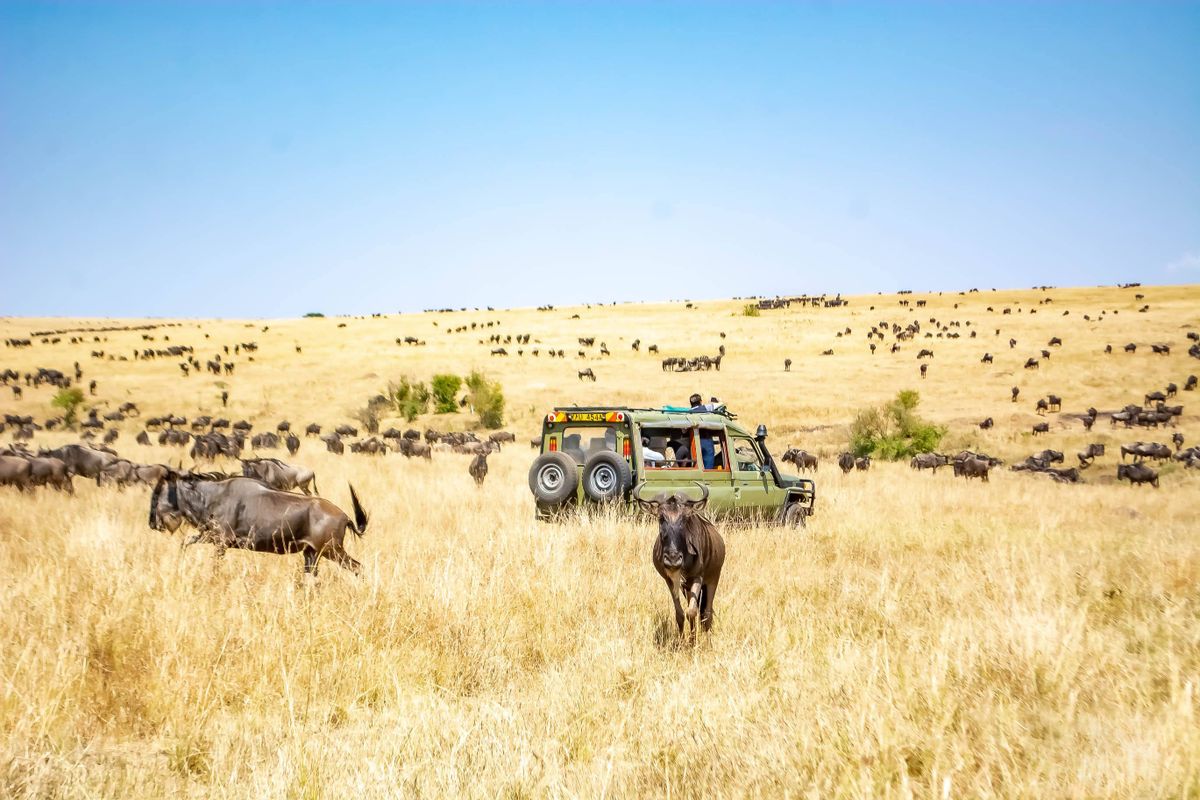
African states need tourism's dollars to pay their debts. So they build tourism for the dollar, not for themselves.
Sub-Saharan Africa's external debt service hit a record $100bn, owed in dollars. Tourism is one of the few things that earns them. So states build it for the dollar-bearing foreigner, not for domestic wealth. Debt is the force underneath every value leak in the series.
African tour operators use AI to write their marketing. The same kind of AI is starting to shape which operators travellers see.
Nearly nine in ten African tourism businesses using AI use it for marketing. But the same technology is beginning to decide which operators a traveller sees at all, owned and trained offshore. The intelligence layer, the top of the value-capture stack. Analysis by Robert N. Katithi.
African states are giving hotels a tax holiday to build what the evidence says they would have built anyway.
Closing a four-part series on where African tourism's value goes. States compete to hand tourism investors tax holidays and deductions, forgoing revenue they cannot spare, for hotels the evidence says would mostly have been built anyway. The one leak the continent inflicts on itself.
Africa sells its carbon at $3 a tonne. The same tonne is worth up to sixty times more once it leaves the continent.
Africa owns the forest, yet others set the price of its carbon. The AfDB's own former president says foreign buyers pay as little as three dollars a tonne while Europe charges around two hundred. He called it a carbon grab. The economic sovereignty of natural capital.
African pension funds are buying the continent's hotels. Five foreign brands keep 80 percent of the control.
Increasingly the money building Africa's hotels is African, often the retirement savings of ordinary workers. But under the management contract the brand keeps operational control and a stack of fees. Owning the building is not owning the business inside it.
Booking.com can't stop a French hotel undercutting it. It can still stop a Kenyan one.
When a foreign visitor books an African lodge through an international OTA, 15 to 30 percent leaves as commission before they arrive, and the operator is contractually barred from winning that guest back. Europe banned these clauses in 2024; Africa hasn't. The mechanism: enforced disintermediation.
Every African state protects its national carrier. Together they have built one of the world's most expensive skies.
Africa agreed to a single air market in 2018, yet only a fifth of its air traffic is intra-continental and flying between capitals is often cheaper through Europe. A coordination failure: every state protects its carrier and taxes the tourism it wants.
When the borders closed in 2020, South Africa's foreign tourism revenue fell 69 percent. The market that held was a nation visiting itself.
Residents outspend foreign visitors nearly four to one in South Africa, and domestic travel carried the sector through the pandemic. Yet the state still builds for the foreigner — because the foreigner pays in dollars and the citizen pays in shillings.
When sovereign wealth buys the coast: Gulf capital, African tourism and the new geography of strategic ownership.
Abu Dhabi's ADQ committed $35bn to a single Egyptian shore; Qatar Airways took 60 percent of Rwanda's new airport; Qatar's Al Mansour pledged $10bn to Zanzibar. Gulf sovereign wealth is taking equity in the asset itself — and it moves with foreign-policy intent.
Africa's largest tourism market already exists. Our foreign-exchange metrics can't see it.
Roughly four in five of the world's tourists travel within their own region; Africa's official figure is far lower. But the market exists at scale — Africans crossing their own borders to trade and visit family, paying in local currency through channels the statistics were never built to count.
A publication of record for African tourism and global political economy.
Tourism in Africa operates inside a global system shaped by power politics, exchange rates, air connectivity, regulatory regimes and shifting demand. Each week, an event somewhere in the world alters what is possible for an operator, an investor or a ministry on the continent. The Corridor distils those shifts into concise, analytically defensible intelligence. Read by tourism ministries, hotel investors, development banks and the analysts who advise them.
Subscribe — free, every Monday