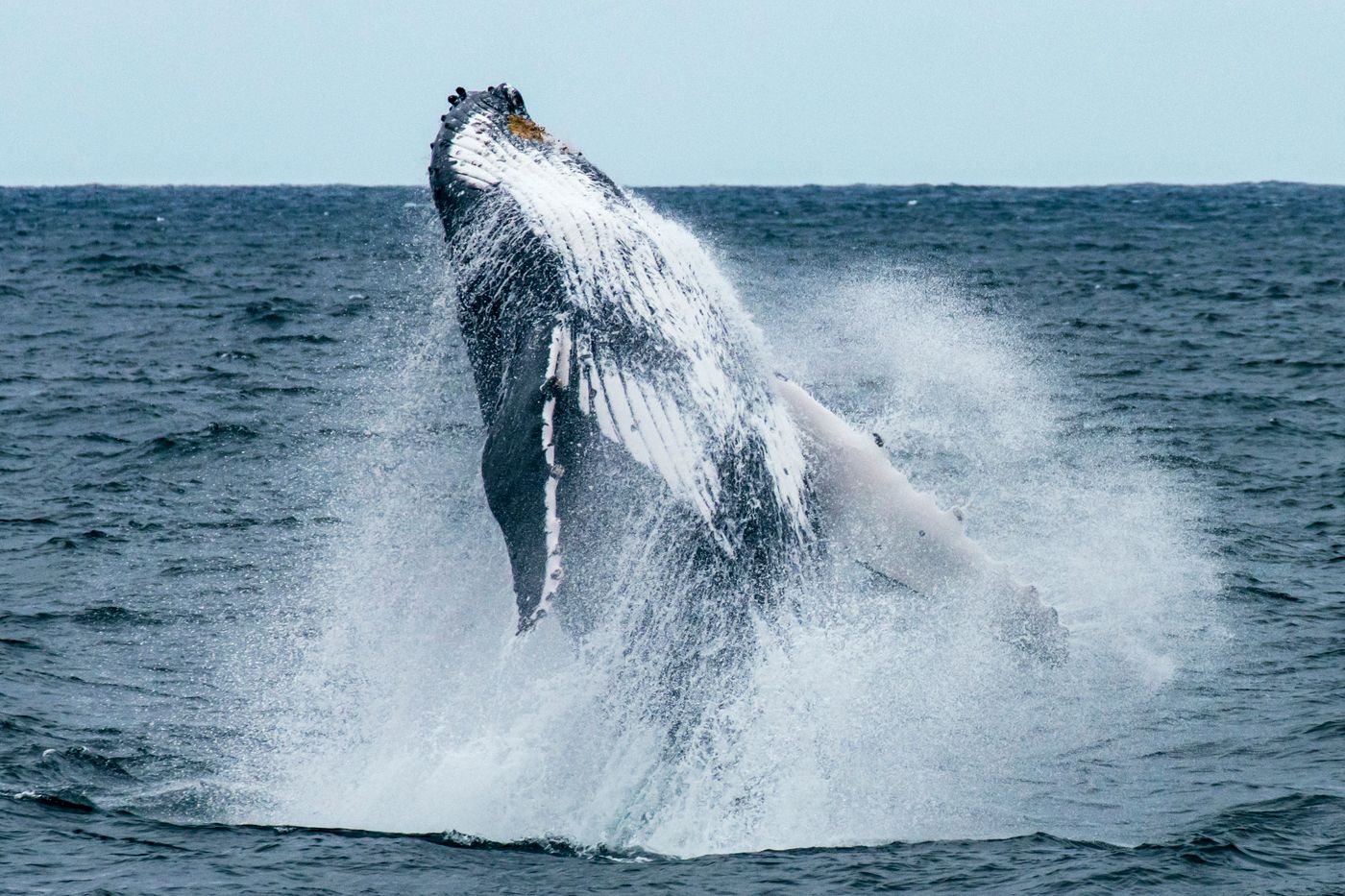
There is a stretch of coast in southern Gabon where the rainforest runs directly onto white Atlantic beach, and along it forest elephants, buffalo and hippos walk the sand while humpback whales breach offshore. Loango National Park has been called Africa's Last Eden, and for once the marketing is close to literal: it is one of the very few places on the planet where a visitor can watch lowland gorillas in the morning and whales in the afternoon. The whales are there as this issue publishes. They arrive from their Antarctic feeding grounds around mid-July and stay until mid-September, and sighting rates at the peak run close to certain. What is missing from the picture is the visitor. The most recent park-attendance figure Gabon's national parks agency has published, cited in an Oxford Business Group survey, recorded 2,500 people visiting the country's national parks in the whole of 2015.1 That number is a decade old, which is itself the point: a country with a first-rank natural asset has published so little tourism data since because there has been so little tourism to measure.
This is the paradox the Climate Re-routing framework exists to read. The framework normally tracks how climate events redraw the map of what is bookable, sending demand toward new places or stranding it. Gabon is the inverse case: a country that has done the expensive, difficult, globally praised work of protecting an extraordinary natural asset, and captured almost none of the tourism value that protection was supposed to generate. Travel and tourism contributes about 0.8 percent of GDP, roughly XAF 93 billion in 2022, a figure that has barely moved in a decade.2 The question worth asking is not why Gabon failed to protect its environment. It manifestly succeeded. The question is why protection and conversion came apart, and the answer runs through the way the protection was financed.
What Gabon actually built
In 2002, President Omar Bongo created thirteen national parks in a single stroke, placing roughly 11 percent of the national territory under protection, a share exceeded by almost no country on earth. Some 85 percent of Gabon remains forested, part of the Congo Basin that constitutes the world's second-largest tropical carbon sink.3 On top of the land came the sea: the Gabon Bleu initiative, launched in 2012, turned 27 percent of the country's marine waters into protected areas, creating the habitat the humpbacks return to.3 The World Bank's Gabon Economic Update, published in June 2025, is devoted entirely to valuing this: the report frames the country's forest ecosystem services as the core of its national wealth and names ecotourism explicitly as a sector Gabon could grow but has not.2 The protection is real, current and institutionally recognised. It is the rare African conservation story where the state, not a foreign foundation, holds the deed.
That distinction is worth pausing on, because this publication has traced the alternative twice. Issue 013 examined Virunga, where a Belgian foundation manages the Congolese state's oldest national park on more than $180 million of European money. Issue 019 traced how Rwanda prices a single gorilla population at $1,500 while its neighbours charge a third of that. Both were studies in conservation as outsourced sovereign architecture, value protected and often captured by actors other than the state. Gabon looked, on paper, like the country that would keep the architecture in national hands. It protected more, earlier, and with its own agency, ANPN, nominally in charge. The puzzle is why national ownership of the asset has not produced national capture of the flow.
The instrument that financed the wrong half
In August 2023, two weeks before the coup that ended fifty-six years of Bongo family rule, Gabon completed the second-largest debt-for-nature swap ever arranged. With the Nature Conservancy structuring the deal and the US International Development Finance Corporation insuring it, Gabon bought back roughly $500 million of its sovereign debt at a discount and redirected the savings toward marine conservation over fifteen years.4 It was, on its own terms, an achievement: Africa's first such swap involving private creditors, a template other coastal states are still trying to copy. But look closely at what the instrument was built to do. A debt-for-nature swap converts expensive debt into cheaper debt on the condition that the savings fund conservation: patrols, marine management, monitoring, enforcement. It finances the guarding of the asset. It does not, and structurally cannot, finance the airport, the road, the lodge or the domestic flight that would let a paying visitor reach the asset. The swap paid to protect the whales. It did not pay to build the way to the whales.
Critics noted at the time that the deal was smaller than it looked, retiring only about 4 percent of Gabon's debt and leaving a large 2025 Eurobond maturity essentially unaddressed.4 That critique was about debt relief. The tourism critique is different and sharper: even had the swap been twice the size, more conservation funding would not have produced more visitors, because visitor numbers in Gabon are not constrained by how well the parks are guarded. They are constrained by how hard the parks are to reach. A gorilla trek at Loango is capped at four guests, four times a week, reached by charter from Libreville at costs that place Gabon among the most expensive safari destinations on the continent. No amount of marine-protection financing changes that arithmetic. The money went to the half of the problem that was already working.
The swap paid to protect the whales. It did not pay to build the way to the whales. The money went to the half of the problem that was already working.
The model stalls at the worst moment
The timing now turns against the mechanism. Debt-for-nature swaps depend on political-risk insurance from bodies like the US DFC, and that support has been curtailed under the current US administration; the Nature Conservancy confirmed in March 2026 that no new African swaps have closed since, though it is working with multilateral banks and private insurers to restart them.4 So the financing instrument Gabon pioneered has stalled continent-wide precisely as Gabon's new government, under President Brice Oligui Nguema, elected in April 2025 after the 2023 coup, stakes its legitimacy on diversifying away from oil.5 Oil output is projected to fall about 3 percent in 2026, and the government's published diversification bets are construction, gas and manganese processing, not tourism.5 A sector that is 0.8 percent of GDP does not command the capital that mining and construction do, which means the conversion gap is at risk of hardening into permanence: the protection is paid for, the extractive alternatives are funded, and the visitor economy sits unfinanced in between.
The honest limit of this argument
There is a version of this critique that overreaches, and it should be named. It is possible that Gabon's remoteness makes the way in uneconomic to finance at any price. The country is genuinely hard to reach, its domestic aviation is thin, its costs are high, and low-volume high-value ecotourism of the kind Loango can support may never move a national GDP figure regardless of what is built, because the model caps its own numbers by design; four gorilla visitors at a time is not a mass market. If that is true, then the debt-for-nature swap financed the only part worth financing, and the conversion gap is a feature of the product, not a failure of the instrument. This is the strongest counter-argument, and the evidence does not fully settle it. What tilts the balance back is Cabo Verde, examined in last week's issue: another small, remote, oceanic African state that decided the way in was worth building, handed its airports to a concessionaire on a 40-year contract, and grew traffic 60 percent in three years. Access, where someone chooses to finance it, responds. Gabon has not yet made that choice, and no instrument on its books is currently designed to.
Three tests over the next year
The first test is whether the Oligui Nguema government names tourism as a diversification pillar in fiscal terms, with a line item, rather than in the aspirational language every Gabonese government since 2002 has used. The National Tourism Strategy that ran 2015 to 2025 promised 20,000 jobs; the decade has closed without them, and a new plan that repeats the promise without financing the access will fail the same way.1 The second is aviation: whether any operator is given terms to build domestic and regional lift to the parks, the Cabo Verde move, since a park a visitor cannot reach is a carbon store, not a destination. The third is whether the next generation of conservation finance is written differently, to fund conversion as well as protection, blending the debt-for-nature model with the infrastructure financing the development banks exist to provide. Gabon holds one of the strongest conservation hands in Africa. Whether it ever turns natural capital into national income depends on financing the fifty miles between the airstrip and the beach, which no swap it has signed was ever meant to cover.