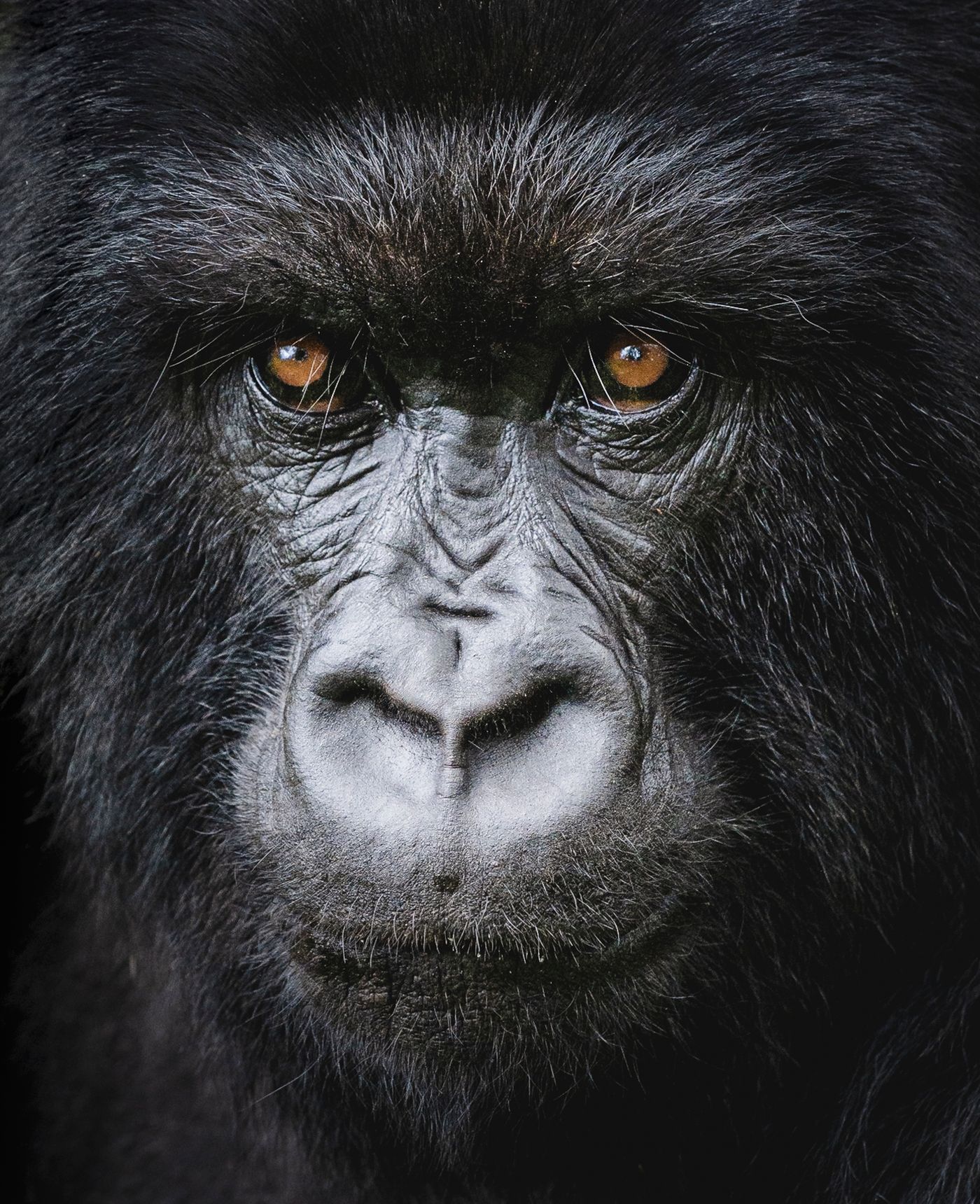
A mountain gorilla permit in the Democratic Republic of the Congo costs $400 when Virunga National Park is open to international tourists, which it has not consistently been for most of the past four years.1 A mountain gorilla permit in Uganda's Bwindi Impenetrable National Park costs $800. In Rwanda's Volcanoes National Park, where the same Albertine Rift forest ecosystem continues unbroken across the border, the permit costs $1,500.2 The animal is the same. The forest is the same. The species is the same. The price spread is not about wildlife. It is about the cost of state capacity.
Rwanda's pricing reflects a state that can guarantee its asset. The visitor knows they will arrive, be received, be protected and leave with the experience they paid for. Uganda's pricing reflects a state that can guarantee its asset most of the time. The DRC's pricing — when it can be quoted at all — reflects something else entirely. It reflects the price discovery of an asset whose operational security cannot be reliably guaranteed by the sovereign state under whose nominal authority the asset sits. Tourists are not paying $400 for less impressive gorillas. They are accepting a discount for the operational risk of visiting an asset that may close, on short notice, due to factors the Congolese government does not control.
The defence is the architecture
The Sovereign Tourism Architecture framework this publication has applied to Botswana and Senegal in the preceding two issues reads the structural capacity of a state to govern its tourism economy as the test of the sector's strategic maturity. Botswana operates inside its own currency but inside a fiscal envelope shaped by diamond receipts. Senegal operates inside a serious tourism reform programme but cannot set its own monetary policy. The Democratic Republic of the Congo, applied to the same framework, presents the structural case in extremis. The Congolese state does not, in operational terms, defend Virunga National Park. The defence is conducted by the Institut Congolais pour la Conservation de la Nature in formal terms, by the Forces Armées de la République Démocratique du Congo in episodic terms, and in continuous operational terms by the rangers of the Virunga Foundation, funded substantially from European public and private capital.
Emmanuel de Merode, a Belgian aristocrat who holds the honorary title of prince and who has served as park director since 2008, took over full management of the property in 2011 under a public-private partnership agreement with the Congolese government.3 The European Union has been the single largest funder of the foundation since its establishment, with cumulative contributions exceeding $180 million according to investigative reporting by Follow the Money and The Continent.4 The Buffett Foundation, Howard G. Buffett's personal philanthropic vehicle, has also been a substantial funder. The Virunga Foundation operates Mikeno Lodge, runs hydroelectric power stations, maintains a 700-plus ranger force, employs European special forces instructors for ranger training, and manages tourism revenue when tourism is permitted.
The Foundation has, in operational terms, become the state for purposes of Virunga's territorial administration. ICCN remains the legal authority and continues to assert that legal authority publicly. The fiscal, operational and security architecture is substantially provided by a foreign-registered charity.
The cost of defending an asset the state cannot defend
Virunga's operational record provides the most documented case study in the world of what it costs to defend a tourism asset against sustained armed opposition. More than 200 rangers have died in the line of duty since the park's establishment under Belgian colonial administration in 1925.5 More than 170 of those deaths have occurred in the past two decades. The deadliest single incident in the park's recent history occurred on 24 April 2020, when twelve rangers and a driver were killed in a militia attack in which four local civilians also died. The bloodshed continued in 2023 with multiple ranger fatalities through the year. The park's mountain gorilla sector came under the operational control of the M23 armed group following the November 2021 attack on the Bukima guard post; ranger patrols in that sector were suspended, and gorilla monitoring continued through local community trackers funded under a Rapid Response Facility grant.6
The Foundation's response to this operational environment has been to construct, in functional terms, a sub-state apparatus. Ranger selection processes are described in the National Geographic coverage as comparable in rigour to military special forces selection. Training is conducted by European special forces instructors. The Foundation maintains its own intelligence and logistics capabilities. It controls access to the park entirely. The Congolese army has, by Emmanuel de Merode's own account, frequently been unable to defend villages on the park's perimeter, leaving the rangers to provide both park security and de facto civilian protection during periods of intense militia activity.5
The Foundation has, in operational terms, become the state for purposes of Virunga's territorial administration. ICCN remains the legal authority. The fiscal, operational and security architecture is substantially provided by a foreign-registered charity. The Sovereign Tourism Architecture framework, applied honestly, has to read this arrangement as something other than what its formal description claims.
The cost is borne by the rangers, by the Foundation's donors, and ultimately by the visitors when the park is open to receive them. The $400 permit price does not reflect the actual operational cost of bringing a single tourist into Virunga to spend an hour with a habituated gorilla family. The Foundation does not publish unit economics on this basis, but reasonable estimation drawing on the park's $18.5 million operational budget reported to UNESCO in 2023, the gorilla sector's share of visitor activity, the security overhead per visitor day, and the ranger-to-visitor ratio during operational periods suggests the true cost of safely conducting a single gorilla trek substantially exceeds the permit price. The shortfall is filled by the EU, the Buffett Foundation, and the Foundation's other donors. The tourist is, in economic terms, the consumer of a heavily subsidised security product to which gorilla viewing is appended.
The Kivu-Kinshasa Green Corridor is the model's scale test
The model has now been scaled. In May 2025, the Government of the Democratic Republic of the Congo, with EU backing of approximately $90 million in additional pledged funding, granted the Virunga Foundation management of the Kivu-Kinshasa Green Corridor — a protected zone covering more than 550,000 square kilometres, an area nearly the size of Kenya, home to more than 30 million people.4 The corridor was announced and authorised without significant parliamentary debate. A member of the environmental committee of the Congolese National Assembly, Robert Agenong'a, has stated publicly that the Parliament was not able to debate the project and that the affected population was not consulted.
The Sovereign Tourism Architecture framework reads this development as the most consequential conservation-economy decision in Central Africa in a decade. The model that Virunga has tested — outsourced operational management of a flagship protected area to a foreign-registered foundation under public-private partnership — has been scaled to an area of jurisdictional responsibility nearly seventy times larger than Virunga itself, before the original arrangement has produced evidence of sustained sovereign capacity transfer or local economic transformation. The Virunga hydroelectric programme, which was the foundation's signature local-development initiative, set a target of connecting one million local residents to electricity by 2020 and creating 60,000 jobs. By 2025 reporting, 39,000 households had been connected against a perimeter population of approximately five million, and fewer than 12,000 jobs had been created.4 The model is being scaled before it has been tested.
The three sovereign architectures of the Albertine Rift
The same mountain gorilla population inhabits three sovereign jurisdictions. The total population was last formally censused at 1,063 individuals across the Virunga Massif and the Bwindi Impenetrable Forest, and the species was reclassified by the International Union for Conservation of Nature from critically endangered to endangered in 2018.7 The animals do not recognise the borders. The tourism architectures do.
Rwanda has structured its tourism economy around the Volcanoes National Park product with explicit reference to high price, low volume, premium-segment positioning. The Rwanda Development Board manages the asset directly. The state controls security, controls permitting, controls revenue collection, controls reinvestment. The $1,500 permit price is the highest in the world for any single wildlife encounter and is sold out twelve months in advance during peak season. Rwanda's tourism receipts attributable to gorilla tourism alone are estimated at upwards of three-quarters of total tourism revenue from the high-value segment.
Uganda has structured its product around a mixed architecture. The Uganda Wildlife Authority is the operational manager. Permits at Bwindi at $800 are not sold out twelve months in advance but generally fill three to six months out. The product is positioned as a more accessible alternative to Rwanda with a similar quality of wildlife encounter, lower-cost lodging options, and a longer total trekking experience. Uganda runs a state-managed sovereign tourism architecture that prices below Rwanda by design and captures higher volume.
The Democratic Republic of the Congo's Virunga sits at $400 not because the experience is less valuable but because the operational risk discount is doing the price discovery. The state does not directly manage the asset in operational terms. Tourism revenue, when it is collected, flows through Foundation channels rather than the Congolese treasury. The conservation outcomes are, by independent measure, strong: the gorilla population has grown, ranger training has improved, anti-poaching capacity is high. The sovereign tourism architecture, in the framework's strict sense, is weak. The state has secured neither the operational architecture nor the fiscal flow.
What the framework predicts
The Sovereign Tourism Architecture framework, applied across the three jurisdictions, produces a testable prediction. The Rwandan model maximises sovereign capture but commits the state to bearing security and reputational risk directly. When the Volcanoes National Park asset is compromised — by disease, by ecosystem stress, by regional security spillover — the cost is borne by the Rwandan fiscal authority. The Ugandan model dilutes sovereign capture in exchange for slightly reduced risk exposure and broader tourism volume. The Congolese model approaches zero sovereign capture on the operational tourism economy and externalises risk to the Foundation and its donors, but produces no sustained sovereign capacity gain because the architecture under which the asset is governed does not develop Congolese state capacity. It substitutes for Congolese state capacity.
The structural question for the Congolese government and for the European Union as the dominant funder is whether the Kivu-Kinshasa Green Corridor expansion is intended to scale a transitional arrangement that will eventually transfer to Congolese state capacity, or whether it is intended as a durable model in which the Congolese state will continue to act as nominal sovereign while a foreign-registered foundation provides the operational architecture. Both options are defensible. They are not the same arrangement. The framework predicts the second option will produce conservation outcomes superior to no protection at all but materially inferior conservation-finance outcomes for the Congolese state, the Congolese tourism economy and the Congolese local population.
Three tests over the next eighteen months
The Virunga and Kivu-Kinshasa arrangement will be readable against three specific tests in the next eighteen months. Each is a test of the architecture on its own terms.
The first is whether the Kivu-Kinshasa Green Corridor governance framework includes statutory provisions for Congolese state capacity development, with measurable milestones, or whether it leaves the operational arrangement open-ended. The framework predicts the former produces eventual sovereign capture, the latter produces durable foreign management. Both are visible in the published text of the agreement, which has not yet been laid before the Congolese Parliament in any sustained form.
The second is whether tourism receipts from Virunga, when the park is operationally able to receive visitors, flow through Congolese treasury channels at any meaningful share, or whether they remain substantially within Foundation accounts. The Foundation's own annual reports provide partial visibility into this question. ICCN's reporting is less consistent. The honest assessment is that current arrangements do not produce reliable national tourism receipt data attributable to Virunga because the architecture is not built for that visibility.
The third is whether the M23 conflict's resolution, when and if it comes, produces a sustained reopening of Virunga to international tourism. The product can only function as a tourism economy if it is operationally available to receive tourists. The current intermittent status is not a viable tourism architecture in any conventional sense. Whether the Foundation can deliver consistent operational availability in a post-M23 environment will reveal whether the model is a tourism architecture or a conservation-security architecture with tourism appended.
Botswana, in Issue 011, is building tourism state capacity from within an intact monetary sovereign. Senegal, in Issue 012, is building tourism state capacity from within a constrained monetary sovereign. The Democratic Republic of the Congo, in Issue 013, is operating a tourism asset in conditions where state capacity is substantially outsourced to a foreign foundation. The three cases together describe the spectrum of Sovereign Tourism Architecture in contemporary African economies. The Virunga case is the structural limit of the framework. Whether the state can recover capacity over an asset it has temporarily ceded is the question that will define the next decade of conservation-finance economics across Central Africa. This publication will continue to track it.