At Lake Baringo, in Kenya's central Rift Valley, the Senior Warden's office at the Lake Baringo Chief Warden's station recorded a fifteen-metre rise in the lake's surface elevation across three months at the peak of the 2020 flood season.1 The water did not recede. Soi Safari Lodge, which had hosted forty to sixty tourists daily and over a hundred on weekend peaks, lost more than fifty rooms to the rising lake. Dozens of staff were laid off. Roberts Camp, which generated more than KSh 20 million in annual revenue, is destroyed; its twenty workers are jobless. Long'icharo Island, formerly home to a population of endangered Rothschild giraffes, is no longer an island. The giraffes had to be relocated.2
At Lake Bogoria, ninety kilometres south, the National Reserve's revenue has fallen from KSh 100 million in the 2019 financial year to KSh 35 million in 2024, a sixty-five percent collapse over five years. Ninety percent of the geothermal hot springs that defined the visitor experience are now submerged.3 The lake itself has expanded from 34 square kilometres in 2019 to more than 45 square kilometres in 2024, a thirty-three percent surface area increase in five years. At Lake Naivasha, the dominant tourism lake of the central Rift, more than 5,000 people have been displaced in the past twelve months alone. Farms that were once two kilometres from the shore are now underwater.4
This is not the climate story the East African tourism sector planned for.
The regional signal is satellite-verified
The damage at each individual lake is documented in local press and in operator-level reporting. The phenomenon underneath is regional and structural. A 2024 study published in the Journal of Hydrology by Hunter and colleagues analysed satellite Earth observation and open-access data products to quantify changes in lake water volumes, total catchment water storage anomalies and environmental drivers for 375 lakes across the East African Rift System between 2000 and 2023.5 The study found that 205 of those lakes recorded significant surface area increases. The cumulative expansion across the central East African Rift came to 71,822 square kilometres. Lake water volumes increased by 1,375.2 cubic kilometres over the same period.
The drivers identified in the peer-reviewed analysis are increasing rainfall and land-use intensification, with statistically significant positive correlations for both catchment forest cover and urban development. The southern Rift System, by contrast, recorded water storage declines over the same period. Several Ethiopian Rift lakes also experienced declining water levels. The climate signal is asymmetric: rising water in central East Africa, declining water in the south of the same system. This is not a uniform pattern of climate-driven water scarcity. It is something more complicated, and the tourism sector has read it as neither.
What the tourism sector assumed
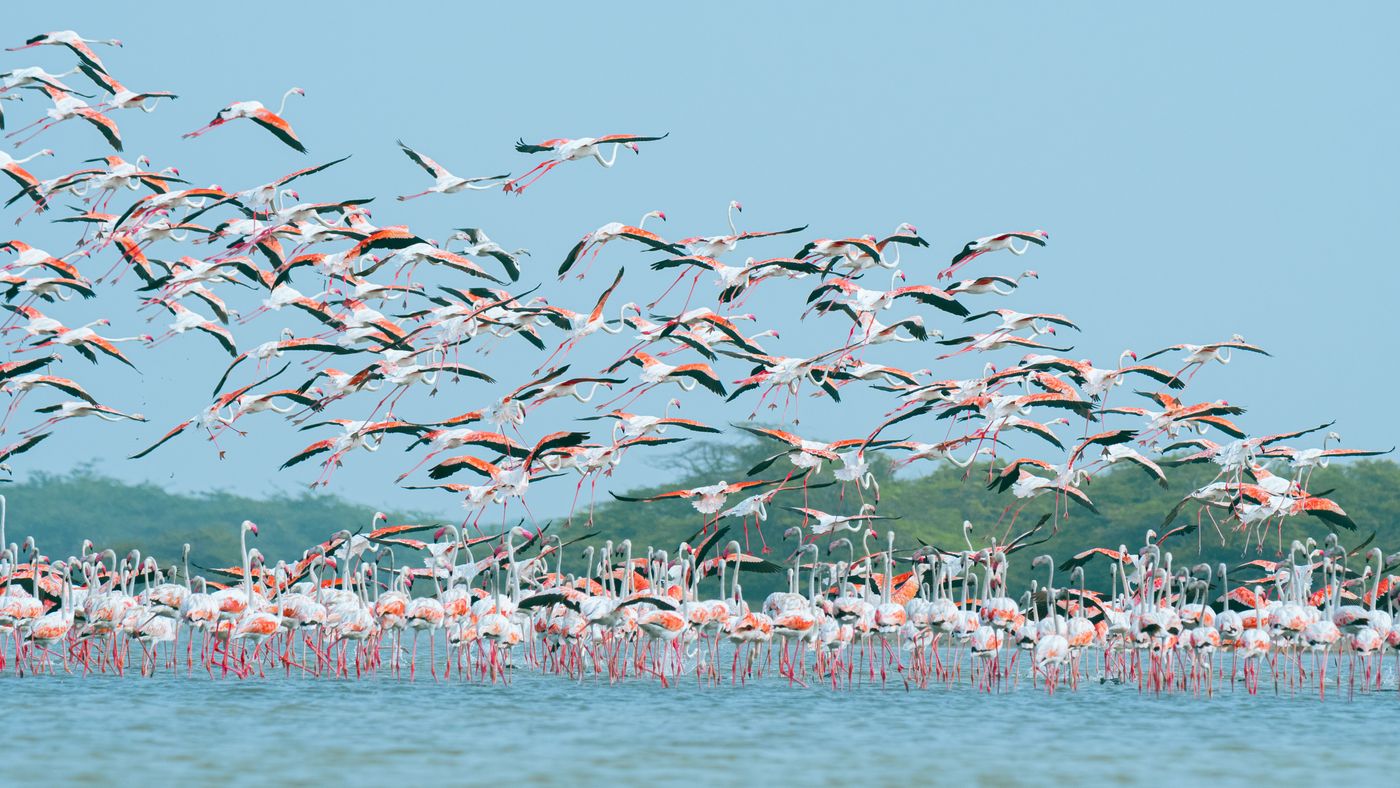
The lakeside investment architecture of Kenya's Rift Valley was constructed during a period when the dominant climate narrative for the region was the threat of receding water. Lake Naivasha in particular had been studied through the 1990s and 2000s for declining water levels driven by upstream abstraction, irrigation for the flower export industry, and a series of drought years.6 Operators built lodges, jetties, viewing platforms and shoreline access infrastructure on the assumption that the shoreline was either stable or retreating. Camping grounds were laid out close to the water. Boat launches were sized for the existing lake. Wildlife viewing corridors at Lake Nakuru's flamingo concentrations were designed around the flamingos' preference for particular shallow alkaline shorelines that had been geographically stable through the late twentieth century.
The Kenya Lake System in the Great Rift Valley, comprising Lake Bogoria, Lake Nakuru and Lake Elementaita, was inscribed on the UNESCO World Heritage List in 2011, with the inscription citation referencing the specific shoreline ecosystems and shallow alkaline waters that supported the dense flamingo populations and the geothermal features at Bogoria.7 The inscription, in other words, formalised in international law a description of physical conditions that the climate has since substantially altered. The hot springs the World Heritage Committee cited are largely underwater. The shorelines have moved. The shallow alkaline conditions the flamingos require are present in different locations than the inscription described.
Simon Onywere, who teaches environmental planning at Kenyatta University in Nairobi, has been documenting the rising lake phenomenon for more than a decade. His assessment, given to the Associated Press in December 2025, was direct: "The lakes have risen almost beyond the highest level they have ever reached."8 The Kenya Meteorological Department researcher Richard Muita has attributed the rises substantially to above-average rainfall trends across the catchment, with secondary geological factors. Both researchers agree the phenomenon is persistent rather than cyclical. The lakes are not flooding episodically. They are at a higher baseline.
The climate that arrived was the inverse
The dominant climate-change narrative applied to East African tourism, particularly by Western analytical institutions, has been the threat of drought. The Mara River basin reductions. The expected effect on wildebeest migration timing. The Kilimanjaro glacier retreat. The 2023 East African drought displacement crisis. Each of those is real and each has shaped how tourism operators and ministries have planned for climate adaptation.
The Rift Valley lake rises are the inverse signal. Climate change in this region, over a quarter-century, has produced more water across central East Africa, not less. The wettest portions of the climate cycle have been wetter. The driest portions, while still dry, have been compressed in their duration. The net effect on lake water volume has been substantially positive. The same climate signal has produced more water around Naivasha and Bogoria, and less water in Ethiopian Rift lakes a few hundred kilometres north. The asymmetry within a single regional system is itself the analytical finding.
The tourism architecture of Kenya's Rift Valley was built for a climate of receding water. The climate that materialised produced more water. The structural problem is not that climate change is happening. It is that the climate change that happened was the inverse of what the sector planned for, and the sector has not retrofitted.
This matters because adaptation strategies designed around climate scarcity look different from adaptation strategies designed around climate excess. The water-conservation infrastructure, the irrigation efficiency upgrades, the drought-resilient agriculture, the careful aquifer management — these are the standard climate adaptation moves for the East African tourism economy. They do not address what is actually happening at the Rift lakes. The infrastructure that is being engulfed cannot be saved by water conservation. It can only be relocated, abandoned or rebuilt at a higher elevation, and none of those options has been resourced.
Who pays for the adaptation
Kenya's lakeside tourism operators are private businesses operating in counties whose revenue base depends substantially on lake-related visitor receipts. The Lake Bogoria revenue collapse from KSh 100 million to KSh 35 million is Baringo County's revenue collapse. Baringo County has not received compensating central government transfers to offset the loss, and the cost of relocating and rebuilding the visitor infrastructure on higher ground has not been allocated in the county or national budgets. The Kenya Wildlife Service, which manages Lake Nakuru National Park, has faced similar revenue compression but operates inside a national budget that has competing demands.
A 2021 study cited in subsequent Kenya National Assembly discussions estimated that 75,987 households around the Rift Valley and Lake Victoria basin had been affected by rising waters, with total displacement and infrastructure costs to the Kenyan economy estimated at KSh 4 billion.9 That figure has not been adjusted upward for the continuing rises through 2022 to 2025. The true current cost is significantly higher.
The honest reading of the situation is that climate adaptation finance, as it currently flows to Kenya through the United Nations Framework Convention on Climate Change processes and bilateral climate aid programmes, is overwhelmingly structured around drought adaptation and food security rather than around flooded-tourism-asset reconstruction. There is no current institutional pathway for a Kenyan tourism operator who has lost a lodge to rising lake waters to claim against climate adaptation finance in the way an Ethiopian smallholder farmer affected by drought might. The architecture of climate adaptation finance, like the architecture of the tourism investments themselves, was designed for the scarcity case.
The structural lesson
This publication's Climate Re-routing framework reads climate change effects on African tourism through three specific channels: what becomes bookable, what becomes more or less expensive to operate, and what becomes structurally re-routed from one destination to another. The Rift Valley lake rises operate on all three channels simultaneously. Bogoria and parts of Baringo have become substantially less bookable in operational terms because the assets have been damaged or destroyed. The operating costs at Naivasha and Nakuru have risen as operators face flood mitigation expenditure, insurance premium increases and shoreline reconstruction. And the broader Rift Valley tourism corridor risks being re-routed away from lake-edge experiences toward elevated terrestrial alternatives — game drives, walking safaris, cultural tourism — that were not the central product the sector was built around.
The corridor-level question is whether the Rift Valley tourism economy can adapt within its current architecture or whether the architecture itself requires structural redesign. The honest analytical reading is that the latter is required. Lodges that are underwater cannot be defended. Hot springs that are submerged cannot be made visible again. UNESCO World Heritage citations that reference physical conditions which no longer exist cannot be defended on their original terms. The sector requires a redesign that has not been planned, funded or politically scoped.
Three tests over the next eighteen months
The Rift Valley lake rise will be readable against three specific tests in the next eighteen months. Each is a test of the adaptation response on its own terms.
The first is whether the Kenya National Treasury and the affected county governments establish a formal Rift Valley Tourism Adaptation Fund or equivalent mechanism, separate from general climate adaptation finance, to capitalise the relocation and reconstruction of damaged lakeside tourism infrastructure. Without a dedicated mechanism, the financial losses fall entirely on private operators, county budgets and worker livelihoods, with no national-level recovery pathway. The fiscal year 2026/27 budget process, currently in mid-year revision, is when this would be addressed if it is going to be addressed.
The second is whether the Kenya Wildlife Service publishes a revised Kenya Lake System management plan that acknowledges the changed physical conditions and proposes either a re-inscription approach to the UNESCO World Heritage Committee or a substantive adaptation plan for the existing inscription. The current management plan operates on the assumption that the conditions of the 2011 inscription remain substantially intact. They do not. The next UNESCO periodic reporting cycle for African World Heritage properties is scheduled for 2026 to 2027. That is when the gap between the inscription and the physical reality has to be addressed in international heritage terms.
The third is whether private tourism operators along the affected lakes consolidate, exit or attempt to rebuild at higher elevation. The current pattern is operator-by-operator improvisation, with some lodges relocating short distances inland on their own capital, some closing permanently, and some attempting to maintain operations with progressively reduced room counts. None of these is at scale. The Kenya Tourism Federation, the Tourism Regulatory Authority and the Kenya Association of Tour Operators have not, at the time of writing, produced a sector-level adaptation strategy for the affected lakes. Whether one emerges in the next eighteen months will indicate whether the Kenyan tourism industry has the institutional capacity to coordinate adaptation, or whether the adjustment will be left to market forces and individual operator survival.
Issue 011 of this publication examined Botswana building tourism state capacity inside its own monetary sovereignty. Issue 012 examined Senegal building tourism state capacity inside a constrained monetary sovereignty. Issue 013 examined the Democratic Republic of the Congo operating a tourism asset where state capacity has been substantially outsourced. Issue 014 examined Egypt converting an existing tourism architecture into a fiscal instrument. Issue 015 examines a different relationship between state capacity and tourism economy: the case where the physical assets the architecture was built around have changed, and neither the state nor the private sector has restructured the architecture to match. The climate did not consult the planners. This publication will continue to track what the planners do in response.