On 25 February 2026, the Executive Board of the International Monetary Fund completed the combined fifth and sixth reviews of Egypt's Extended Fund Facility, unlocking a tranche of approximately $2.3 billion and bringing cumulative drawings to $5.2 billion of the $8 billion programme expanded in March 2024.1 The Board's communique attributed the improvement in Egypt's external position to "strong remittances and tourism receipts." That two-word phrase, tucked inside a routine IMF press release, names the analytical fact this issue is built around. Egypt's current account deficit has narrowed from a position that threatened sovereign default in early 2024 to 4.2 percent of GDP in fiscal year 2024/25. The narrowing has been carried, in material part, by visitors with cameras and queues at the Grand Egyptian Museum.
This is an unusual macroeconomic configuration. A nation of 110 million people, the most populous in the Arab world, with a manufacturing base, a sovereign hydrocarbon endowment, a strategic maritime chokepoint and the Suez Canal, is depending on its tourism economy to anchor its IMF programme. The Corridor Index framework this publication applies to questions of capital flows and tourism unit economics reads this as a category shift. Tourism is no longer a sector that contributes to GDP. It is, in the precise technical sense, an instrument of fiscal sustainability. The function has changed even if the ministry of tourism's mandate has not.
What the numbers carry
Egypt welcomed approximately 19 million international tourist arrivals in 2025, a 21 percent increase on the 15.78 million recorded in 2024, which itself had been the previous all-time record.2 The growth rate placed Egypt second globally for arrivals growth, behind only Brazil, and well above the 5 percent global average reported by UN Tourism in January 2026. International tourism receipts grew 17 percent year-on-year, ranking Egypt third globally for revenue growth behind Morocco and South Korea. The Q1 2026 data, released in early May, reported 5.6 million arrivals and $5.1 billion in receipts, a 43.5 percent year-on-year increase against an annual target of $24 billion. The Ministry of Tourism and Antiquities is publicly targeting 30 million arrivals by 2028.3
The headline numbers describe a sector outperforming. The macroeconomic numbers describe something different. Egypt's fiscal year 2024/25 GDP grew 4.4 percent. Inflation, which had peaked above 38 percent in 2023, fell to 11.9 percent by January 2026. The current account deficit narrowed to 4.2 percent of GDP from a position that had been substantially worse before the March 2024 currency adjustment. The IMF's February 2026 review attributed those improvements explicitly to two foreign currency channels: remittances from Egyptians working overseas, and tourism receipts. The two channels are doing the macroeconomic work that the Suez Canal can no longer do.
The Suez Canal cannot do this work anymore
The macroeconomic transition has a specific cause. The Houthi attacks on Red Sea commercial shipping that began in late 2023, ostensibly in protest at the Gaza conflict, decimated transit through the Suez Canal. Canal revenue fell from $10.25 billion in 2023 to $3.991 billion in 2024 according to the Suez Canal Authority's own reporting, a structural loss of approximately $6 billion in annual foreign currency earnings.4 The Egyptian government's own estimate, cited by the Middle East Institute, places cumulative losses above $8 billion through March 2025. Transit volumes through 2025 remained at approximately a third of pre-conflict levels. The IMF's published Egypt FAQ as of mid-2025 confirms the depressed Canal receipts continued into the first five months of 2025.5
The Canal is not a tourism asset and falls outside the analytical scope of this publication in the ordinary case. It enters the analytical scope here because the absence of $6 billion in annual Canal revenue is what makes tourism receipts structurally load-bearing for the IMF programme. The IMF Executive Board's explanatory language in the February 2026 review is precise: macroeconomic stabilisation depends on the combination of fiscal discipline, exchange rate flexibility, structural reform, and foreign currency inflows. The fiscal discipline and exchange rate components are policy variables under Egyptian government control. The foreign currency inflow component is not. It depends on remittances, on tourism and on the IMF tranches themselves. Three of the four pillars require external cooperation. Tourism is the one of those three where Egyptian state action — visa policy, infrastructure investment, security architecture, marketing strategy — can directly move the variable.
The Grand Egyptian Museum is a fiscal instrument
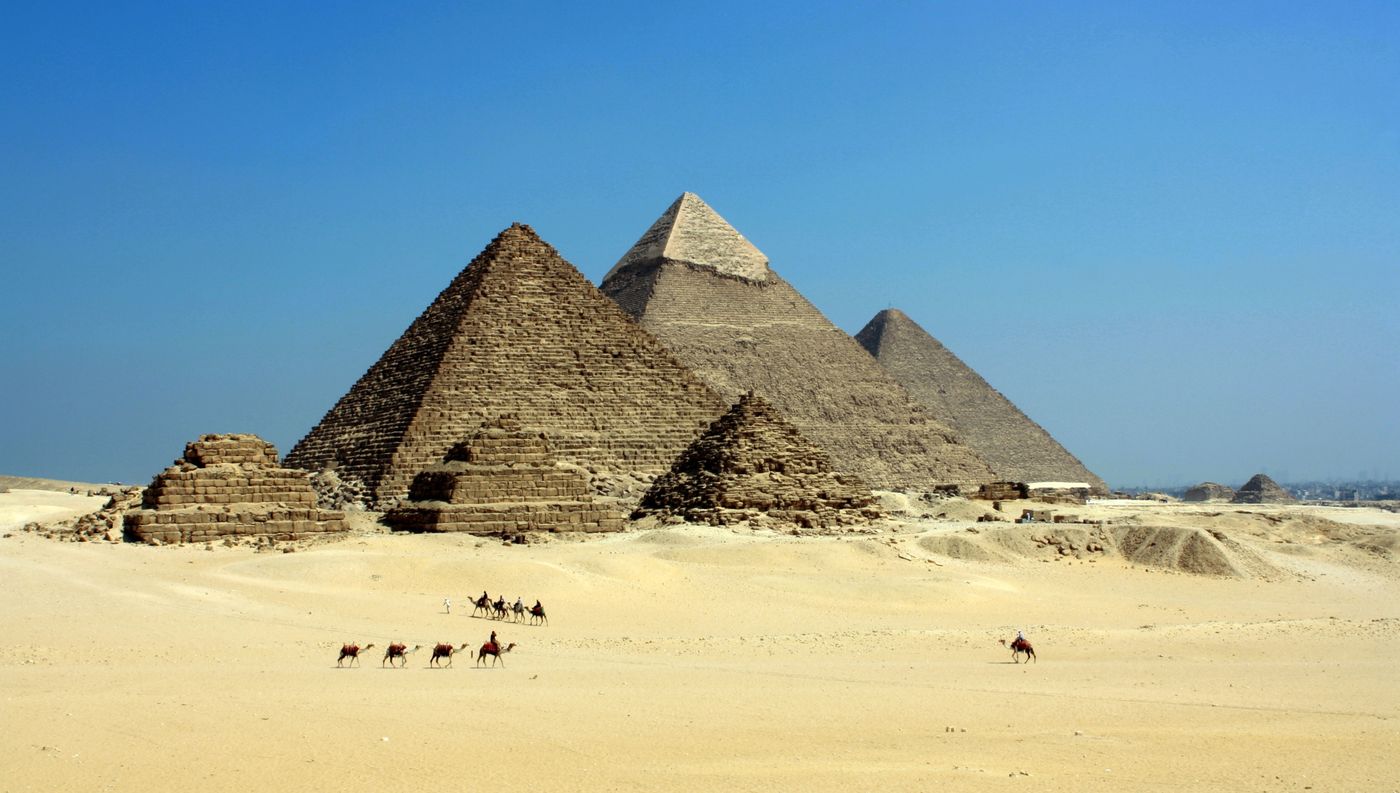
The opening of the Grand Egyptian Museum in November 2025, after more than twenty years of construction at a final cost above $1 billion, has been reported as a cultural landmark. It is also, in the precise macroeconomic sense, a fiscal instrument.6 The Egyptian Ministry of Tourism attributed the 21 percent surge in 2025 arrivals to three named factors: enhanced security conditions, a 32 percent expansion in charter flight capacity into Egypt, and the Grand Egyptian Museum opening. Charter flight traffic in 2025 reached 193 source cities, with traffic to the new resort destination at New Alamein City growing 450 percent. The Q1 2026 surge in arrivals and receipts is being driven substantially by the Museum's continuing draw, with the facility's location adjacent to the Pyramids of Giza extending average length of stay and per-visitor expenditure across the Cairo region.
The Grand Egyptian Museum is housed and described as a cultural institution. Its macroeconomic function in 2025 and 2026 is to convert two decades of state capital expenditure into a sustained annual stream of foreign currency that the Egyptian state needs to keep its IMF programme on track. The Pyramids are not the asset. The Pyramids plus a museum that opens at the moment Egypt's foreign currency position requires structural support — that is the asset.
The timing should be noticed. The Museum had been delayed repeatedly for two decades. Its opening landed within twelve months of the IMF programme expansion to $8 billion and the Ras al-Hikma deal that injected $35 billion in UAE sovereign wealth into the Egyptian fiscal position.7 Whether the timing was deliberate fiscal sequencing or fortunate cultural coincidence is not the analytical question the Corridor Index framework asks. The framework asks what the unit economics of the tourism flow now do for the sovereign capital position. The answer is that they cover an increasing share of the foreign currency requirements the IMF programme conditions on Egypt sustaining.
The structural risk inside the structural success
The IMF's February 2026 review noted, in its standard understated tone, that "downside risks remain significant, particularly those associated with heightened regional geopolitical tensions and tighter global financial conditions."1 Translated out of IMF language, the sentence reads: if the Gaza-Israel-Hezbollah-Houthi-Iran regional security architecture deteriorates further, the tourism receipts that are carrying the current account improvement could reverse rapidly. The Corridor Index framework reads regional geopolitical exposure as the single largest unit-economics risk for any tourism economy whose source markets and transit corridors traverse the eastern Mediterranean. Egypt is more exposed to that risk than any other country in the IMF's Africa-MENA portfolio, because its tourism economy is structurally larger and because its geographic position places it adjacent to every relevant flashpoint.
The 2025 performance demonstrates a remarkable resilience. Tourism arrivals grew 21 percent in a year that included sustained Houthi attacks, the continuing Gaza conflict, the Hezbollah-Israel exchanges, and the Iran-Israel escalations of the latter half of 2024. The Q1 2026 data continues that pattern. But resilience is not invariance. The IMF programme runs through December 2026. The Egyptian fiscal position requires tourism receipts to continue growing through that period and into 2027 to meet the divestment, debt-servicing and currency stability targets the programme is structured around. The structural risk is not that tourism fails to grow. It is that the growth rate, currently above 17 percent on revenue, slows to the 5 percent global average. At that rate the foreign currency contribution becomes insufficient to fill the Suez Canal gap, and either the Canal recovers (depending on the Houthi resolution that Egypt does not control) or the IMF programme requires renegotiation on terms less favourable than 2024.
What the Corridor Index reads in this case
The Corridor Index framework focuses on the unit economics of tourism corridors as instruments of sovereign capital position. The conventional reading of a country's tourism sector treats it as a quasi-discretionary component of GDP, growing or contracting with global demand cycles and producing employment, foreign currency and tax revenue as second-order outputs of leisure consumption. Egypt in 2026 is not that case. The Egyptian state has, in the precise technical sense, monetised its sovereign cultural assets — the Pyramids, the Valley of the Kings, the Nile cruise corridor, the Red Sea resort architecture, and now the Grand Egyptian Museum — as foreign currency instruments to fill a balance of payments gap that the Canal can no longer fill.
This produces three observable consequences in Egyptian state behaviour. The first is the prioritisation of security and air connectivity infrastructure investment over almost any other tourism-related capital expenditure. The 32 percent charter flight expansion and the Cairo airport upgrades reflect a state allocating capital to the constraints on tourism volume rather than to the constraints on tourism quality. The second is the prioritisation of arrival volume over per-visitor receipt, which is the opposite of the Rwandan or Botswanan tourism architecture and the same as the Moroccan one. The 30 million arrivals target by 2028 is a foreign currency target dressed as a tourism target. The third is the increasing willingness of the Egyptian state to absorb sovereign-stake investment from Gulf partners — Qatari Diar's $29.7 billion luxury coastal development pledged in November 2025, the UAE's Ras al-Hikma development — in exchange for foreign currency at the front end and tourism revenue diversion at the back end. Each of these is rational given the framework Egypt is operating inside. The structural cost is that Egyptian sovereign control over its tourism architecture is being diluted by the same fiscal pressure that makes the receipts so valuable.
Three tests over the IMF programme's remaining months
The Egyptian programme runs through 15 December 2026. The Corridor Index will be tracking three specific tests in that window. Each is a test of the relationship between the tourism economy and the sovereign capital position, not a test of the tourism economy on its own.
The first is whether tourism receipts continue at or above the 17 percent year-on-year growth required to fill the Canal revenue gap as it persists. A growth rate of 10 percent would be considered strong for any global tourism economy. For Egypt it would be insufficient. The Q1 2026 data is consistent with the higher trajectory. The Q2 and Q3 data, due through August and November, will determine whether the trajectory holds across the full programme period.
The second is whether the next IMF review, expected in mid-2026, attributes continued current account improvement to tourism in the same explicit language the February 2026 review used. The IMF's published language on what is carrying Egypt's external position is itself a market signal. Sustained explicit attribution of tourism as a structural foreign currency channel changes the way ratings agencies, sovereign creditors and FDI investors price Egyptian risk. The language is the policy.
The third is whether the Egyptian government completes the divestment commitments it has already missed once. The IMF has agreed a revised divestment timeline of $3 billion in the current fiscal year and $2.1 billion in the next, after the previous $3 billion target produced only $600 million in actual proceeds. The divestment programme is the structural reform component of the IMF arrangement that does not depend on tourism. If tourism continues to perform but divestment underdelivers, the programme's overall sustainability gets weaker even as the external balance looks better. If divestment delivers but tourism slows, the structural reform balance improves but the external position deteriorates. The combination that produces a successful programme exit is both lines performing simultaneously. Watching how the Egyptian state allocates political capital between these two priorities through the rest of 2026 is the analytical territory that will define whether the IMF programme is judged a success.
Issue 011 of this publication examined Botswana building a tourism architecture inside its own monetary sovereignty. Issue 012 examined Senegal building a tourism architecture inside a constrained monetary sovereignty. Issue 013 examined the Democratic Republic of the Congo operating a tourism asset with substantially outsourced state capacity. Issue 014 examines an inversion of the previous three. Egypt is not building a tourism architecture. It is converting an existing one into a fiscal instrument. The Corridor Index framework will be tracking that conversion through the remaining IMF programme period. The terms on which Egypt exits the programme — or fails to — will reveal whether this is the new model of African macroeconomic management or a one-time response to a specific Canal disruption. This publication will continue to track it.