On the evening of 3 July, in Miami, a 24-year-old named Sidny Lopes Cabral curled a shot into the top corner against the reigning world champions, and a country most of the watching audience could not place on a map was level with Argentina in extra time of a World Cup knockout match. Argentina's winner arrived eight minutes later, deflected in from a Lionel Messi corner, and the run was over: a goalless draw with Spain, a comeback draw with Uruguay, a third draw with Saudi Arabia, second place in the group, and the record as the smallest nation ever to reach the tournament's knockout stage.1 Cabo Verde's goalkeeper, a 40-year-old known as Vozinha who last season kept goal in the Portuguese second division, finished the month with roughly 20 million new social media followers, a following nearly forty times his country's population.1
Sporting histories will record the football. This publication's interest is in what happened at the same time on the world's booking screens, because for a tourism economy the size of Cabo Verde's, four matches functioned as the largest marketing event in the country's history, delivered free, to audiences it has never been able to reach. The Corridor Index framework reads destination economies through their unit economics: what a visitor is worth, who captures the value, and what the state retains. Applied here, it asks the question the celebration coverage has not: attention arrived at unprecedented scale, but the machine that converts attention into receipts was built by others, for other purposes, and most of it is not in Cabo Verdean hands.
The shock arrived through a search bar
The demand signal is unusually well documented for an event this recent. During the tournament, American Google searches for "Cabo Verde vacation" rose more than 5,000 percent against the previous year and registered as a breakout term on Google Trends. Expedia recorded a rise of more than 800 percent in searches from US users. TUI, the European operator that dominates the destination's package market, said searches doubled against June 2025. Interest from Japan, a market with effectively no history in the archipelago, rose 110 percent.2 These are the numbers destinations pay nine-figure sums to generate. Qatar spent an estimated $220 billion hosting the 2022 World Cup partly to purchase this kind of recognition. Cabo Verde produced a comparable burst of it with a squad drawn substantially from the European lower divisions and a federation budget invisible at global scale.
The geography of the surge matters more than its size. The United States supplied 1.1 percent of Cabo Verde's foreign hotel guests last year; American curiosity is therefore growth from almost nothing, in the world's largest outbound travel market. The same applies to Japan. The countries that already send visitors did not need a World Cup introduction, which means the shock is concentrated precisely where the destination's existing machinery is weakest.2
The machine the attention will meet
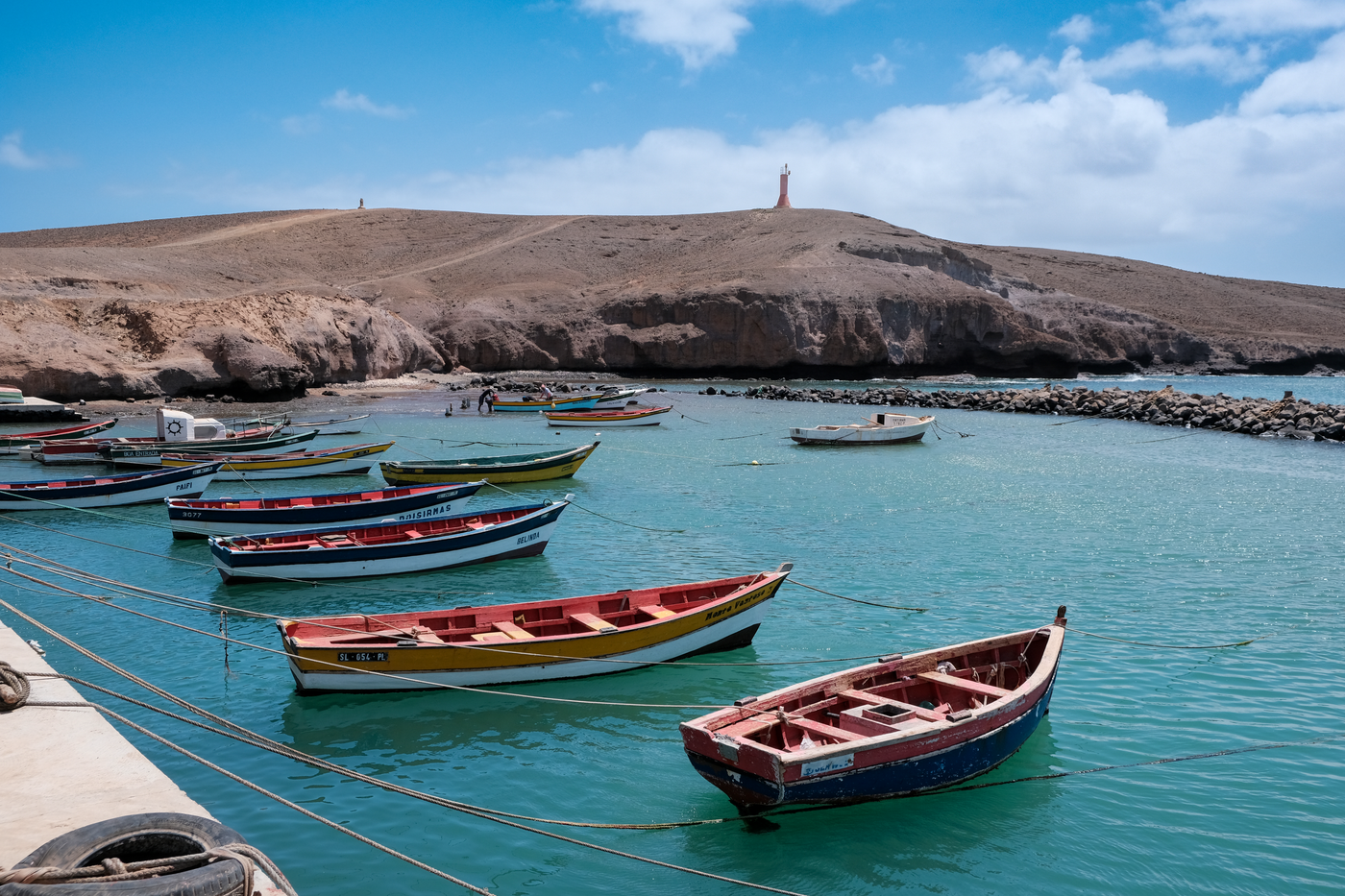
Tourism produces roughly a quarter of Cabo Verde's GDP directly and drives around 40 percent of its economic activity, a dependence that made the country's pandemic contraction the second worst in Sub-Saharan Africa and its recovery, at above 7 percent growth in 2024 and 6.3 percent in 2025, among the strongest.3 But the sector's shape is narrow in three compounding ways. Seven European countries supply more than 70 percent of arrivals. About 80 percent of bed-nights are spent on two of the nine inhabited islands, Sal and Boa Vista, in a resort strip built for the charter market. And the dominant product is the all-inclusive package, sold by foreign operators, in which flights, rooms and meals are paid abroad and the visitor has little reason to spend beyond the perimeter fence. The result shows up in a single number: average onshore visitor spend of €41 a day, against €238 in the Canary Islands, the Spanish archipelago four hundred kilometres to the north selling roughly the same sun to roughly the same Europeans.3
None of this is an accident, and little of it is a scandal. The all-inclusive model gave a drought-prone ten-island microstate with almost no exports a functioning growth engine, upper-middle-income status as of July 2025, and its first fiscal surplus since 2007.3 The model works. What the model cannot do is convert a global attention shock, because it was engineered to import a known European customer through a charter pipeline, not to receive a curious American, a Japanese couple, or a football fan who wants the country rather than the resort. The World Bank's Economic Update for Cabo Verde, published six days before this issue, names the binding constraint without mentioning football at all: unreliable and costly inter-island transport that concentrates activity on Sal and Boa Vista and prevents the rest of the archipelago from participating in the sector's growth.5 The attention is arriving addressed to a whole country. The infrastructure can deliver it to two islands.
Who owns the conversion
Follow the new demand through the system and count who collects. The searches happen on American platforms. The package, if one is booked, is sold by TUI of Germany or Meliá of Spain, and the margin books abroad. The aircraft lands at an airport operated by VINCI of France, which holds a 40-year concession over all seven of the country's airports, its first in Africa, with ANA of Portugal owning the remaining stake. The concession has performed: traffic is up 60 percent since 2022 on the back of 35 new routes, an €80 million modernisation finished in January, and a €142 million expansion now under way.4 The hotel room is priced in a currency, the escudo, fixed at 110.265 to the euro since 1999, which means the exchange rate cannot cheapen the destination to meet new demand and monetary policy is effectively written in Frankfurt.5 At each stage the arrangement is defensible, and several were sought by the government precisely because the state could not finance them alone. The cumulative effect is still striking: the asset that produced the attention, eleven men in blue shirts, is among the few links in the chain that Cabo Verde wholly owns.
The country's deepest connection to the new demand is not commercial but human. More Cape Verdeans live abroad than in Cabo Verde, in Portugal, France, the Netherlands and above all New England, and the diaspora's remittances supply more than a tenth of GDP and six reserved seats in the national parliament.5 The single air link to the United States runs from Providence, Rhode Island, the diaspora heartland, where Cabo Verde Airlines flies to Sal and Praia once or twice a week.4 That is the entire physical channel between a 5,000 percent search surge and the beaches being searched for: a national carrier's narrow lifeline, built to carry grandmothers and remittances, suddenly asked to carry a demand shock.
The asset that produced the attention, eleven men in blue shirts, is among the few links in the conversion chain that Cabo Verde wholly owns.
Searches are not arrivals
An honest reading requires the caveat the headlines skip: as of publication there is no arrivals, booking or revenue data showing the surge converting, and search interest decays fast.2 The precedent most often cited is Morocco, whose arrivals climbed from 10.9 million in 2022, the year of its World Cup semi-final, to 14.5 million in 2023 and onward to Africa's most-visited destination, though Morocco began with an aviation gateway, a diversified product and a marketing budget Cabo Verde does not possess. The fairer comparison may be with the country's own trajectory: arrivals grew 16.5 percent in 2024 to 1.18 million and set a record again in 2025, on low-cost route growth that predates any football.3 The World Cup did not create Cabo Verde's momentum. It created a one-time option on top of it, and options expire.
Three tests over the next twelve months
The first test is airlift: whether any carrier adds transatlantic capacity beyond the Providence lifeline, or whether VINCI's route-development machinery, which added 20 routes in 2025 alone, produces a North American or Asian link while the attention is warm. Seats are the hard currency of conversion; searches without seats are sentiment. The second is distribution: whether the $75 million World Bank tourism diversification programme and the new expansion phase move any measurable share of bed-nights beyond Sal and Boa Vista, which is the only way the €41 figure rises, since money is spent where there is somewhere to spend it. The third is the diaspora dividend: the government has courted what it calls ethnic tourism for years against the friction of the very inter-island transport the World Bank flagged; a global moment of pride is the cheapest recruitment campaign that strategy will ever receive, if the connections exist to carry it.5
Issue 012 of this publication read Senegal's rebuilt tourism state against the ceiling of a currency it does not control. Issue 022 finds the smaller, stranger case one archipelago to the northwest: a state that did everything the development textbooks asked, grew at 6 percent, balanced its budget, and then received the one thing no programme can buy, the world's undivided attention, through the least instrumented channel it has. The Corridor Index measures what a visitor is worth to the destination that hosts them. For eleven days in June and July, Cabo Verde was worth more to the world's attention economy than at any moment in its history. Whether any of that value lands onshore now depends on seats, ships between islands, and the speed of institutions that have never had to move at the pace of a news cycle. The window is open. It was opened by a save in the 90th minute, and it will close the same way it opened: quickly.