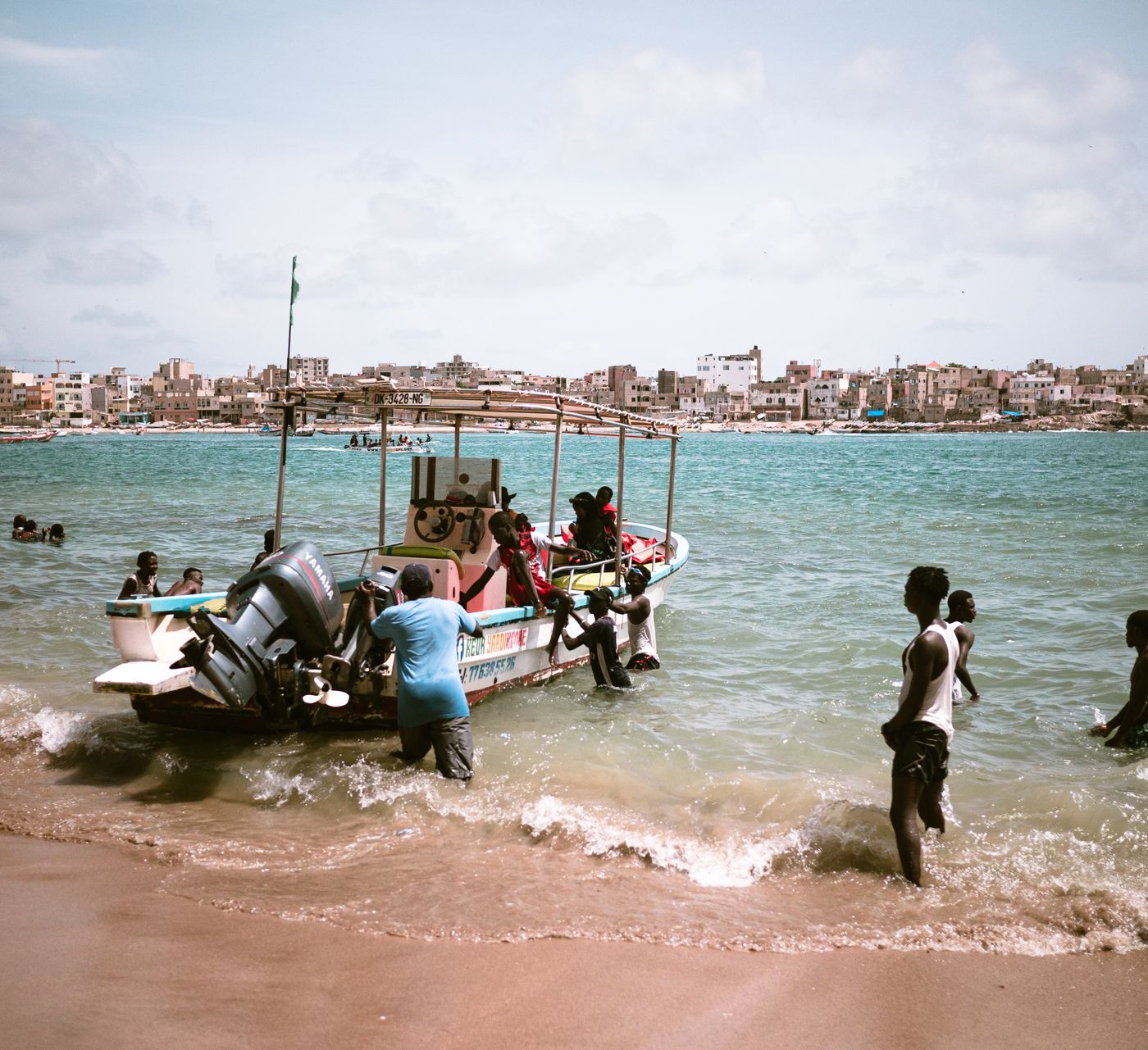
In the first half of 2025, international tourist arrivals to The Gambia rose by 46 percent year-on-year, the highest growth rate recorded for any destination on the African continent in UN Tourism's published barometer data.1 The Gambia is the smallest country on mainland Africa, a sliver of territory along a single river, enclaved on three sides by Senegal, with a tourism economy historically built on British and Nordic winter-sun charters into the Banjul resort strip. Destinations of that profile do not ordinarily post the continent's fastest growth. When they do, the explanation is rarely found inside the destination. It is found in what has happened to the alternatives. The relevant alternative in this case is an entire region. The nearest member of the Alliance of Sahel States sits two borders to the east — across Senegal, into Mali — and what has happened there since 2020 is the largest deliberate withdrawal of territory from the global tourism system in contemporary African history.
This issue applies the Displacement Dividend framework, which this publication uses to read how wars, sanctions and political ruptures redirect tourism flows toward — and within — Africa. The framework's central proposition is that conflict does not destroy tourism demand. It displaces it. The demand that once moved through Bamako, Mopti, Ouagadougou and Agadez did not evaporate when those circuits closed. It re-routed, and the re-routing is now measurable in the arrival statistics of the coastal states. Reading the Gambian number without the Sahel context is a marketing story. Reading the two together is the structural story.
Seven escalations in six years
The closure of the Sahel did not happen in one event. It happened in a sequence whose cumulative effect only becomes visible when the rungs are laid out in order. Mali had coups in August 2020 and May 2021. Burkina Faso had two in 2022, in January and September. Niger followed in July 2023.2 In September 2023 the three juntas signed the Liptako-Gourma Charter, creating the Alliance of Sahel States as a mutual defence pact. At the Niamey summit of July 2024 the alliance upgraded itself to a confederation. On 29 January 2025 the three states formally completed their withdrawal from the Economic Community of West African States, ending decades of membership, and launched a joint biometric AES passport in the same month.3
The external escalations then compounded the internal ones. Mali and Burkina Faso have carried the US State Department's Level 4 "Do Not Travel" designation — the same tier as active war zones — for years. On 30 October 2025, Niger was escalated from Level 3 to Level 4, the same day the State Department ordered non-emergency staff out of the US Embassy in Bamako, placing the entire AES bloc simultaneously on the most severe advisory tier. The Federal Aviation Administration imposed restrictions on US air operations over Malian airspace.4 In December 2025, the United States suspended visa issuance for Malian, Burkinabè and Nigerien nationals. On 1 January 2026, all three AES governments responded in kind, formally banning American citizens from entry and citing the principles of "mutual respect" and "sovereign equality."5 What had been advisory-zoning became formal, legal, bidirectional closure between the Sahel confederation and the world's largest outbound tourism market.
A tourism economy that stops reporting has exited the system
Measuring the Sahel's tourism collapse runs into a problem that is itself a finding. The last arrivals figure Mali reported into the international statistical system is 168,000, for 2021. Niger's is 85,000, for 2020. Burkina Faso's most recent figure is 132,000 for 2024, against tourism receipts that peaked at a verifiable $173 million in 2019.6 Before the 2012 northern crisis, Mali alone received roughly 200,000 visitors a year, drawn to a cultural circuit — Timbuktu, Djenné, the Dogon country — that ranked among the continent's most distinctive. Agadez performed the same anchor role for Saharan tourism in Niger. Those circuits are not merely suppressed. They are statistically invisible, because the states that contain them have substantially stopped producing internationally legible tourism data.
This publication reads that silence structurally. A tourism economy that no longer reports to the international system has, in a functional sense, exited that system — whatever domestic or regional travel continues inside it. The AES has built a joint bank, a joint television channel, a joint passport and a unified military force since 2023. It has built no tourism instrument of any kind that this publication can identify. Tourism is simply not part of the AES state-building project, and the data vacuum is the honest measure of that absence. Meanwhile the United Nations reported through 2025 that communities across northern Mali, Burkina Faso and western Niger were being progressively emptied by insecurity.7 The human displacement and the tourism displacement are the same event observed at different scales.
The flow did not disappear. It moved.
The receiving end of the redirection is documented in the same barometer data that records the Gambian surge. Morocco's arrivals grew 19 percent in the first half of 2025. Ghana's Kotoka International Airport processed more than 1.13 million arrivals in 2024, a record, with the diaspora-anchored architecture built since the Year of Return continuing to compound. Côte d'Ivoire has recovered toward its two-million pre-pandemic baseline. Senegal — whose tourism state-rebuilding this publication examined in Issue 012 — continues its growth trajectory inside the same coastal corridor. Continental arrivals as a whole grew roughly 10 percent through the first nine months of 2025, which means the coastal West African performances are running at two to four times the continental average.1
The Gambia is the cleanest case precisely because it is the smallest. A destination of its scale registers regional redirection the way a small instrument registers a large signal: visibly. The Gambian product — beach, river, birdlife, proximity to Europe — did not change between 2023 and 2025. What changed is the choice architecture around it. Tour operators assembling West African programming no longer have a Sahel to sell. Overland and cultural-circuit demand that would have distributed across the region now concentrates on the destinations that remain insurable, advisable and flyable. The coastal states are not winning a competition. They are absorbing a closure.
Political ruptures do not destroy tourism flows. They redirect them. The Sahel's closure is The Gambia's growth, Morocco's expansion, Ghana's record year. The analytical question is which coastal state converts the redirection into structural receipts — and which merely hosts it until the map changes again.
Hosting the dividend and converting it
The Displacement Dividend framework distinguishes between hosting a redirected flow and converting one. Hosting is passive: the arrivals come because the alternatives closed, and they leave when the alternatives reopen or when the source markets shift. Converting is structural: the receiving state uses the windfall window to build the air capacity, accommodation stock, source-market diversification and institutional depth that retain the flow after the original cause has faded. The distinction matters acutely for The Gambia, whose tourism economy carries a documented fragility: heavy dependence on a narrow set of European charter relationships, exposed brutally when the collapse of Thomas Cook in 2019 removed a major channel almost overnight. A 46 percent surge built on the same narrow architecture is a larger version of the same vulnerability.
The conversion question also runs through the region's monetary plumbing. The AES states remain members of UEMOA and continue to use the CFA franc — meaning Mali shares a currency with Senegal and Côte d'Ivoire while no longer sharing their travel governance. ECOWAS, for its part, announced that AES citizens would retain rights of free movement and residence within the community even after the January 2025 exit, a unilateral guarantee whose reciprocity remains unsettled.8 The practical consequence is a region where money moves on one map, people on another, and tourists on a third. The coastal states that prosper from the redirection are, in several cases, the same states most exposed if the Sahel's insecurity migrates further toward the littoral — a risk that northern Côte d'Ivoire, northern Ghana and northern Benin already register in their own advisory footnotes. The dividend and the exposure travel together.
Three tests over the next eighteen months
The Displacement Dividend framework, applied to the redrawn West African map, identifies three tests to watch through the end of 2027.
The first is the Gambian conversion test. The full-year 2025 and 2026 arrival data will show whether the surge consolidates at a higher baseline or decays as a one-off redistribution effect. The variables that determine the answer are observable: whether Banjul's air connectivity diversifies beyond the UK and Nordic charter axis, whether the Gambia Tourism Board converts the windfall into accommodation investment and source-market spread, and whether the state treats the surge as structural opportunity or seasonal luck. A destination that grew 46 percent on someone else's closure has perhaps two seasons to build the architecture that survives a reopening.
The second is the AES tourism-instrument test. The confederation has produced a bank, a passport, a broadcaster and a joint force in under three years — evidence of genuine institutional throughput where the juntas choose to apply it. Whether any tourism cooperation instrument, however minimal, appears on an AES summit agenda by the end of 2026 will indicate whether the confederation regards its cultural patrimony — Timbuktu, Djenné, Agadez, the Dogon country — as a strategic asset or an irrelevance. Continued absence is itself an answer, and the answer the current trajectory implies.
The third is the free-movement reciprocity test. ECOWAS has unilaterally guaranteed AES citizens' movement rights; the AES has made no equivalent general guarantee, and the January 2026 bans on US citizens demonstrate the confederation's willingness to use entry policy as a diplomatic instrument. Whether the ECOWAS guarantee holds, whether the AES reciprocates for ECOWAS citizens, and whether the mutual bans with Washington extend to other Western source markets will determine whether the closure has reached its floor or continues to deepen. Each further rung on the ladder transfers additional flow to the coast.
Issue 012 of this publication examined Senegal rebuilding the tourism state inside a constrained monetary sovereignty. Issue 014 examined Egypt converting tourism receipts into a fiscal instrument. Issue 015 examined a tourism sector engulfed by a climate it did not plan for. Issue 016 examined the gap between diplomatic signal and operational architecture across three BRICS members. Issue 017 examines the inverse of a state building anything: a confederation of states withdrawing from the tourism system entirely, and the redistribution of flow that withdrawal produces along the West African coast. The closure was political. The dividend is measurable. Whether it becomes structural belongs to the coastal states, and this publication will continue to track which of them do the work.